
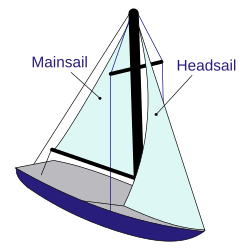
For the Beginning Model Yachting topic “The Rig”, we are going to deal exclusively with the installation of a Bermuda/Marconi rig on a R/C sloop. There are many things you will learn from these articles that can be applied to a model yacht rig on another style of boat, such as a schooner or other model yacht, but there are differences. For simplicity, we will address the remote-controlled sloop-rigged monohull that will cover most of the US VMYG classes and registered boats.
rig: The purpose of the rig is to keep the mast in column side-to-side, control the mast bend fore and aft, and control sail shape and trim position.
When the discussion began about this topic, it seemed simple. We make model yacht rigs all the time. Easy, right? As the work progressed, we realized that it was going to take a lot of words and illustrations to cover everything involved in assembling a rig.

The rig is the engine that drives the boat. Understanding helm balance and the relationship between the rig and the hull are critical to performance of a model yacht. You need to understand the center of effort of the sail plan, the center of lateral resistance of the hull, and the relationship between these two factors when locating the mast/rig on the boat. (See Henderson, John. “Helm Balance, with simple calculations of Center of Effort and Center of Lateral Resistance.” The Model Yacht. 24:1. Winter/Spring 2023.)
There are some questions that may need to be answered before you begin. These should be addressed in the series.
- Is the rig for a boat being built with little dimensional information?
- Is the rig for a boat that is missing the rig, and a new rig must be made?
- Is the boat ready to receive the rig?
- Have the backing pieces been installed for the deck fittings?
- Are the deck fittings placed and if so, are they in the correct position?
- Has mast compression been addressed?
Additionally you must understand your class rule if you intend for your boat to be conforming to a US VMYG or other class. The US VMYG class rules are all available here: https://usvmyg.org/classes/
Standing Rigging and Running Rigging
Rigging consists of standing rigging [R57] and running rigging [R46]. Understanding the difference between them is important.
Standing rigging supports the mast, keeping it upright and in column while allowing some optional pre-bend in the fore-aft direction for sail shape control. Most standing rigging is wire, and none of it is adjusted while sailing. Standing rigging also supports the jib, which—unlike the mainsail—is not attached to the mast along the length of the luff.
Running rigging is used to control sail trim and sail shape, and we will reference separate articles covering the necessary servo arrangements.
The parts and supplies needed for these two aspects of the rig will be reviewed. How and where the fittings get attached to the mast and booms will be covered. Several ways to attach the main sail to the mast will be reviewed.
See the articles “Standing Rigging” and “Running Rigging” by John Henderson.
Getting to Know the Model Yacht Rig Parts and Pieces
There are many fittings, parts, assemblies, and supplies necessary to complete a model yacht rig. We have put together an online resource you can use to learn about them, how they are related, how to make them, and/or where you can find them.
You can start browsing with the Rig Glossary, where each term is defined and linked to pages with more detail.
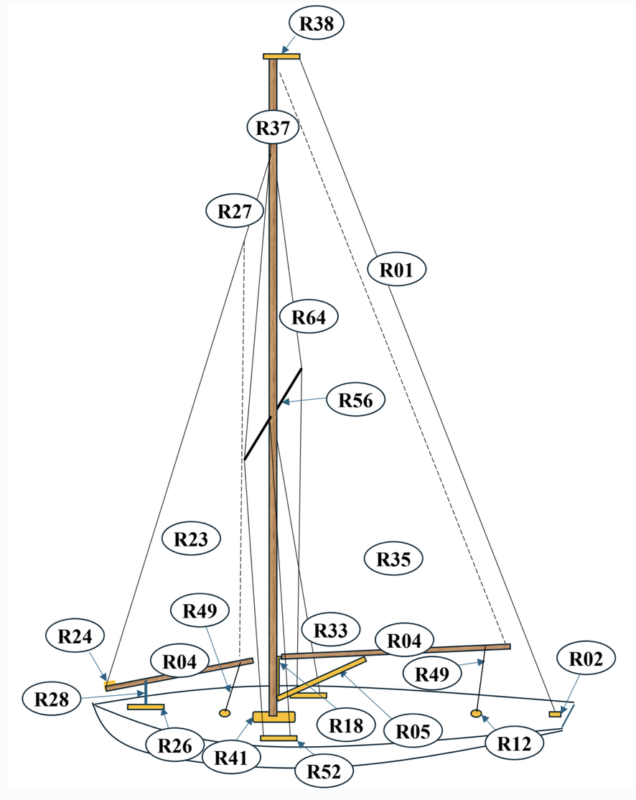
You might prefer to start with the Rig Terms Map, which is a visual glossary. This is a drawing of a model yacht with the items labeled with their term numbers (which correspond to their entry number in the Glossary). When you roll over the term number, you will see the name of the part, and when you click on it you will be linked to pages with more detail.
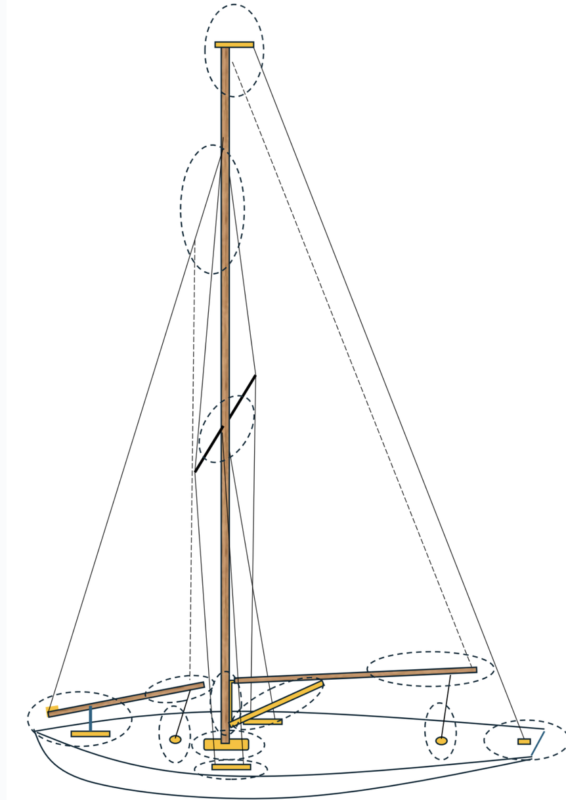
The Rig Areas Map highlights sub-assemblies of the rig. The areas here are linked like the Rig Terms Map but they will zoom you in to each of the highlighted areas for more details.
As you get deeper into the pages, you will find information on where to purchase parts and how to make the assemblies needed to build a rig.
Placement of Deck Fittings
Most early plans do not provide adequate details for locating deck fittings and lack many dimensions helpful in making and installing a rig. It is, therefore, important to understand where to place the fittings for optimum performance.
We spend a lot of time discussing the positions of deck fittings because of the critical relationship between the rig and the deck fitting locations. This relationship is very important to its success of a model yacht on the water. The ideal placement of these fittings is critical.
The following articles should help you figure out what you need to do:
- “Planning Your Deck Fittings.” usvmyg.org. May 2026.
- This article takes you through situations you might find yourself in with your model yacht. These are scenarios that should help you figure out how to arrange your deck fittings. Real boat examples are provided.
- “Placing Your Deck Fittings.” usvmyg.org. May 2026.
- This article provides details on figuring the exact locations of your mast (mast step), shroud racks, jib rack, deck fairleads, and backstay bracket. It starts with locating the mast because everything else keys off of this critical piece.
Masts & Booms
You can make a wooden mast and booms for your model yacht relatively easily. John Henderson wrote two articles in the Spring 2026 issue of The Model Yacht about wooden masts.
- Henderson, John and Stoudt, John. “How to Make a Wooden Mast.” The Model Yacht. 27:1. Spring 2026. pp. 11-15.
- A practical, step-by-step guide to selecting materials, tools, and techniques for constructing strong and effective wooden masts for model yachts.
- Henderson, John and Stango, Victor. “Structural Mechanics of Wooden Masts.” The Model Yacht. 27:1. Spring 2026. pp. 16-22.
- A technical exploration of mast design, explaining the engineering principles—such as buckling and material properties—that determine mast strength and performance.
And we found a related article in Model Builder in the Digital Archive:
- Prough, Don. “Main Sheet: Our online editor takes the mystery out of carving your own mast.” Model Builder. 28:4. March 1974. pp. 26, 62-63.
- The article focuses on how to design and carve an effective mast for a model yacht, emphasizing that it’s a commonly misunderstood part of construction.
Assembling the Model Yacht Rig
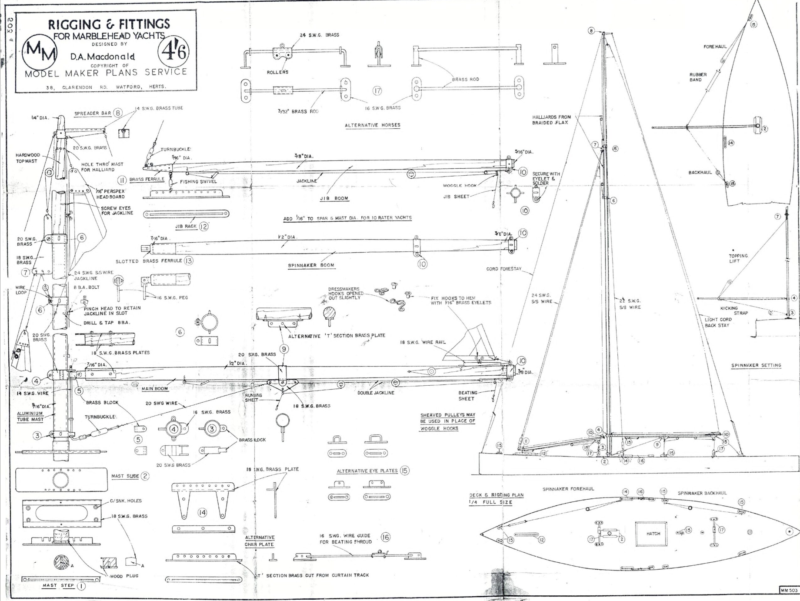
Make sure you have all of the parts and supplies you need and the associated fasteners before you start to assemble the rig. Have the sails ready and your spars made.
- “Assembling a Jib and Main Boom.” usvmyg.org. June 2026.
- The step-by-step process for shaping and installing fittings on your main and jib booms to prepare for final assembly of the rig.
- “Assembling the Mast.” usvmyg.org. June 2026.
- The step-by-step process for sizing and shaping your mast and installing the mast fittings including the optional Jenny stay strut.
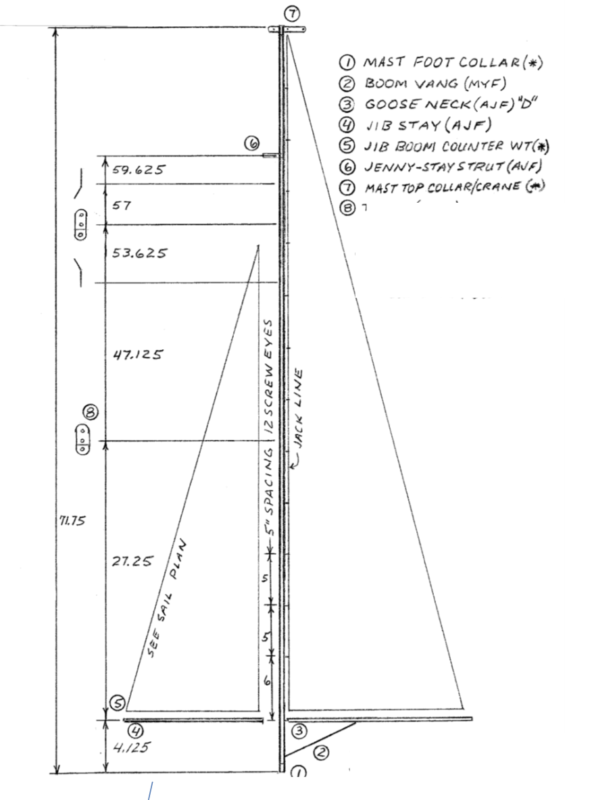
- “Mast Assembly Drawing.” usvmyg.org. June 2026.
- A complete reference drawing of mast assembly including positions of all of the hardware and fittings.
- “The Rig Final Assembly.” usvmyg.org. June 2026.
Electronics Board and Servo Setup
The best way to mount the electronics board in the boat will be discussed, servo setup reviewed, and how to make the necessary adjustments covered.
Finishing Touches
And the last touches, if not already completed, will be reviewed including installing the sail number, class symbol, battens, and wind indicator.
Where Do I Start?
The rig is a rather complex part of a model yacht. This series of articles will enable you to build an effective rig that should give you a successful model yacht and hours of pleasure on the water.