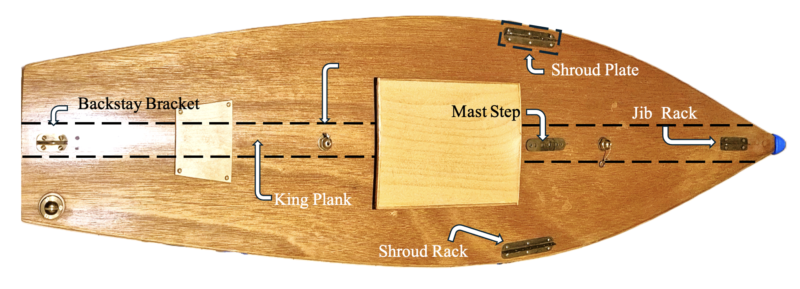
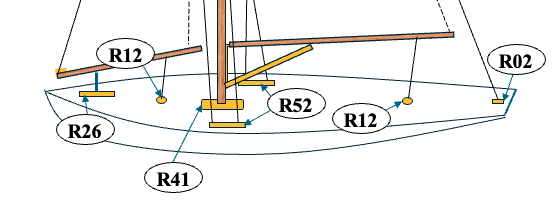
The first thing to do when figuring out where your deck fittings will go is to figure out the position of the mast (R37). All other fittings key off of the position of the mast or specifically the mast step (R41) fitting on deck.
Then you can move on to the backstay bracket (R02), jib rack (R26) and shroud racks (R52), and through deck fairleads (R12). You will need to be sure that you have reinforcing material under the deck to provide backing to increase strength in the areas where the fittings are mounted and to provide extra support for the fasteners. The king plank (R30) and shroud plates (R51) provide the extra backing for these fittings. If you are building a boat, make sure these features are on the plan and added during construction. If you acquired your boat, check they are in place. If not, add them.


Mast Location
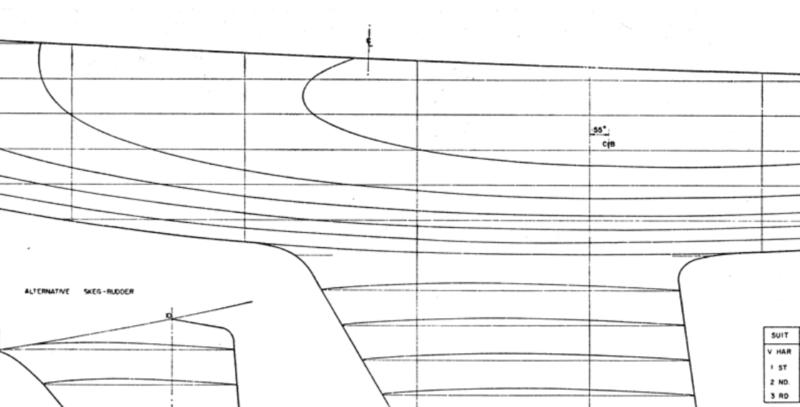
Most plans show the location of the mast in the sheer plan. It often appears on plans as a small vertical line on the deck. This point on the centerline of the boat will be the middle of the mast step when it is fastened to the deck. If you have a full-size plan, the measurement can be taken from the plan and transferred to the boat. If you are looking at a copy of the plan that is not to scale, you can determine the scale (should be noted on the plan) and calculate the location using the scaling factor. The scale can be found on most plans.
The mast location will be aft of the forward deck fairlead and forward of the hatch opening. If you have the dimensions from the plan, the deck layout, or some other indicator, you are ready to go. If you are little unsure, place your mast step on the deck. It should be far enough forward of the hatch opening as not to interfere with the placement and removal of the hatch cover. Consideration must be given to the position of the boom vang on the lower aft edge of the mast. When you are locating the position of the gooseneck (R18) and boom vang (R05) attachment points on the mast you can adjust those positions/dimensions to eliminate the interference. Move the boom vang attachment point up slightly.
Note: If you do not have a hatch opening defined on the plan, calculate the position of you mast BEFORE you decide where the hatch opening should be!
You can calculate the location of your mast or verify it by calculating the Center of Effort (CE) of the sail plan and Center of Lateral Resistance (CLR) of the submerged hull and keel. You will place the CE slightly ahead (roughly 5% to 15% of the waterline length) of the CLR as can be seen below. See the article “Helm Balance, with simple calculations of Center of Effort and Center of Lateral Resistance” from The Model Yacht, Vol 24 No 1, Winter/Spring 2023.
Jib Rack Location
The jib rack (R26) is placed on the longitudinal centerline of the deck. It is located back from the bow the distance the jib swivel (R28) is from the lead edge of the jib boom plus ¼ to ½ inch. You do not want the forward end of the jib boom to stick out past the bow of the boat nor the trailing edge of the jib boom to hit the mast.
Note: The jib swivel on an R/C sailing yacht is 20-25% back from the forward end of the jib boom.
Deck Fairlead Location
There are two deck fairleads (R12) on a model yacht: one located forward of the mast step, and one located aft of the hatch opening. These are generally placed directly under the location on either boom where the sheet (R49) line turns to attach to its counterpart coming out of the deck fairlead.
Shroud Rack Location
The lead edges of the shroud racks (R52) are placed on the deck directly opposite the lateral center line of the mast step (R41), within 1/8 to ¼ inch of the edge of and parallel to the sheer. For positioning purposes, you may need to move these slightly forward of the lateral center point of the mast step.
Backstay Bracket Location
The backstay bracket(R02) is place on the longitudinal centerline on the stern of the deck or at the top of the transom. If it is on the deck, it must be placed far enough aft, so the backstay does not to interfere with the operation of the mainsail.
Before You Start Drilling
Place all of the fittings in their locations and study what you have. Do a full-size mock up. Brown paper for the layout will help. Draw a line to represent the deck and draw in the fittings. Lay out the rig on a table or workbench with the booms, boom vang, mast, and sails in their relative location to each other and the deck. Sketch in lines for the sheets, jib swivel, backstay, forestay and jib halyard. Does the layout work? Does the mainsail clear the backstay? Does the jib boom hit the mast? Generally, study what you have and make necessary.
Related Articles
- Planning and Building Scale Models that Sail. Part 2: Design Calculations
- Helm Balance, with simple calculations of Center of Effort and Center of Lateral Resistance
- An Exercise – Verifying the Mast Location
- Planning Your Deck Fittings